
Top 5 SEO Trends to Watch in 2026
Jump to a Section
Search engine optimization continues to change rapidly, but the biggest shift going into 2026 is not that traditional SEO has disappeared. Instead, search has expanded. Google still ranks webpages, but businesses are now competing for visibility inside AI-generated answers, local results, Maps, images, videos, rich search features, and increasingly complex search experiences.
That makes modern SEO broader than simply placing keywords on a page. Businesses need to demonstrate relevance, authority, reputation, technical quality, and a genuine ability to satisfy what users are searching for.
Some older SEO trends still matter, but their importance has shifted. Voice search, for example, has not disappeared. However, conversational queries are now better understood as part of the much larger movement toward natural-language and AI-driven search.
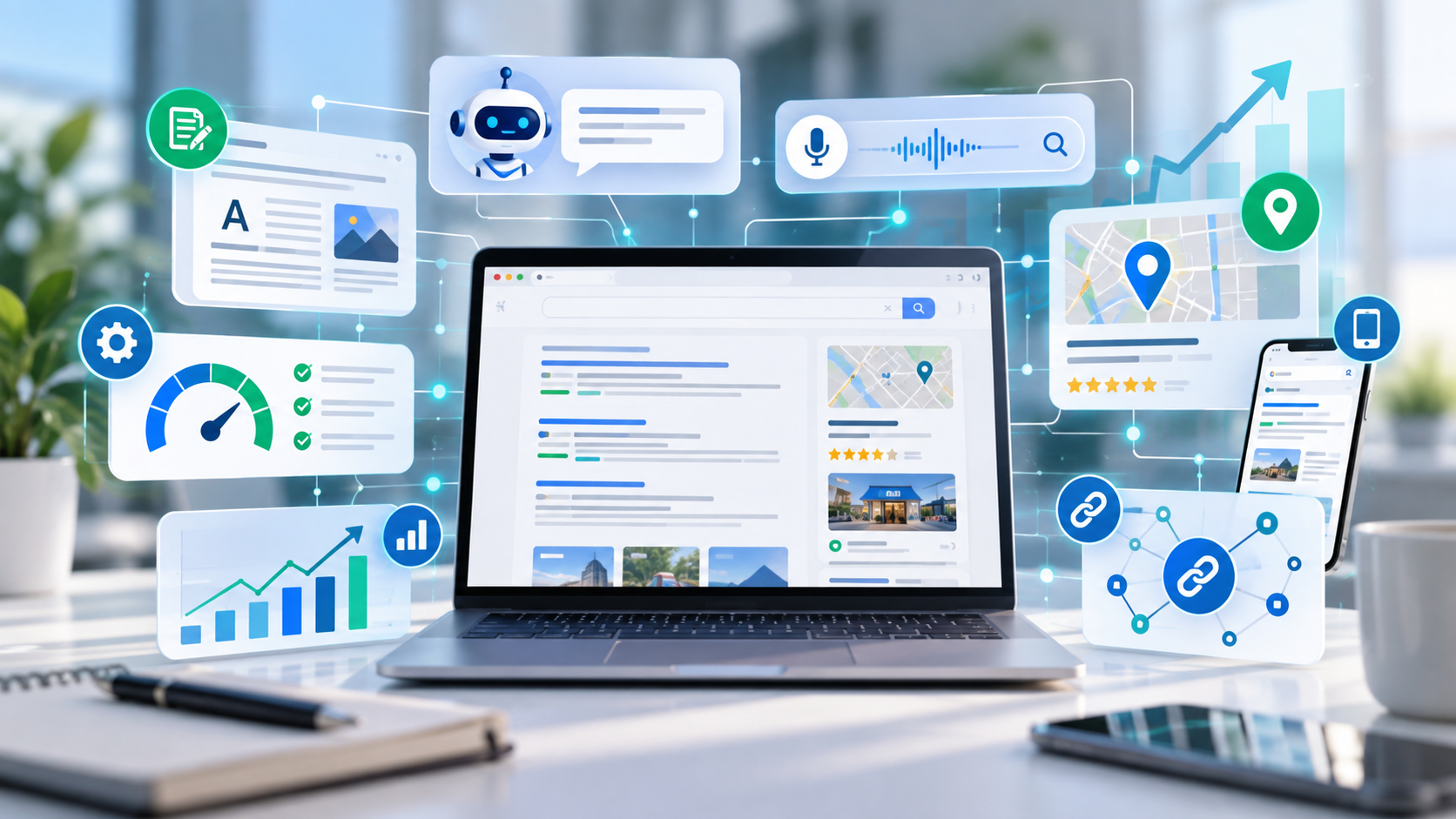
The biggest areas to watch are AI-driven search, expertise and authority, local SEO and online reviews, technical performance and user experience, and visual or multimodal search. These areas overlap, and businesses that integrate them into one comprehensive SEO strategy will generally be better positioned than those chasing isolated tricks.
AI-Driven Search Is Changing What SEO Visibility Means
Artificial intelligence is no longer an emerging feature sitting on the sidelines of search. AI-generated summaries, conversational answers, entity understanding, semantic search, and natural-language processing are increasingly woven into how users find information.
Search engines are becoming better at understanding meaning and intent rather than simply matching words. That means a successful page must do more than repeat a target keyword. It needs to demonstrate that it actually understands the subject and answers the questions surrounding it.
Natural-language processing plays an important role in this transition. Semrush provides a useful overview of natural language processing in SEO and how search engines interpret context and relationships between words.
Search Is Becoming More Conversational
Users increasingly search using complete questions, detailed requests, and conversational language rather than short keyword fragments.
That makes long-tail search increasingly useful. Instead of optimizing only for a phrase such as “Mobile AL plumber,” businesses should also understand searches such as “why does my water heater keep running out of hot water?” or “who repairs sewer lines near me?”
Semrush's guide to long-tail keywords provides additional context for how these more specific searches can be incorporated into a content strategy.
What Businesses Should Do
- Create content around actual customer questions.
- Write naturally instead of forcing exact-match keywords.
- Build detailed topic clusters instead of isolated thin pages.
- Use descriptive headings that clearly communicate page topics.
- Include useful definitions, examples, comparisons, and explanations.
- Make important facts easy for both people and search systems to interpret.
2026 SEO is increasingly about being understood, not merely indexed. Search engines and AI systems need enough context to understand who you are, what you know, what you offer, and when your content is relevant.
Expertise, Authority and Trust Matter More Than Ever
As search engines process an enormous volume of content—including AI-generated material—the ability to determine which sources deserve attention becomes increasingly important.
That makes expertise, authority, experience, reputation, and trust more important to a sustainable SEO strategy.
Publishing large quantities of generic content is no longer enough. Businesses should work toward becoming identifiable sources of useful, accurate information within their industries and markets.
Original Expertise
Publish information grounded in real experience, practical knowledge, examples, case studies, and actual industry expertise.
Authority Signals
Earn legitimate links, citations, mentions, partnerships, and references from relevant websites and organizations.
Trust Signals
Clearly identify the business, authors, credentials, contact information, service areas, policies, and real-world reputation.
This is particularly important in industries involving financial, medical, legal, safety, and other high-impact information. However, credibility matters across virtually every competitive search market.
Search visibility also increasingly extends beyond traditional blue links. A business may be evaluated through its website, online mentions, reviews, business profiles, citations, links, and other information surrounding the entity.
Stop Publishing Content Just to Publish Content
Every article should have a purpose. It should answer something, explain something, demonstrate expertise, support a service, build topical depth, or address an actual customer need. Ten strong articles can be substantially more valuable than fifty pages created simply to hit a publishing quota.
Local SEO, Reviews and Online Reputation Are Becoming Essential
Online reviews deserve their own place among the biggest SEO trends in 2026—especially for local businesses.
For years, reviews were often discussed primarily as a reputation or conversion tool. Today, their role is broader. Reviews contribute to the information available about a local business, influence whether customers choose one result over another, and are part of the larger prominence picture surrounding local search.
That means a strong review strategy can affect both visibility and customer behavior.
Review Quantity Matters
A business with an established history of legitimate reviews presents a much stronger reputation footprint than a business with almost no public feedback.
Review Quality Matters
Star ratings and customer experiences can dramatically influence whether someone calls, clicks, requests directions, or chooses a competitor.
Review Recency Matters to Customers
Prospective customers often care about what people are saying about the business now, not simply what customers thought three or four years ago.
Review Responses Matter
Responding professionally demonstrates that the business is active and attentive. It also gives future customers insight into how the company handles praise, complaints, misunderstandings, and service issues.
Reviews Are No Longer Just Testimonials
Reviews have become part of the information ecosystem surrounding a business. Searchers see them directly in Maps and local results, and review content can help prospective customers understand the services, quality, strengths, and weaknesses associated with a company.
We explore this topic in considerably more detail in Do Online Reviews Impact Google Rankings? The Importance of Online Reviews in SEO .
Local Businesses Should Focus On:
- Consistently earning legitimate customer reviews
- Responding professionally to feedback
- Keeping Google Business Profile information accurate
- Maintaining consistent business information across the web
- Adding quality photos and current business information
- Watching for repeated customer-service issues in reviews
- Avoiding fake, purchased, or incentivized reviews
For local businesses, reputation and SEO are increasingly intertwined. It is difficult to treat online reviews as a separate marketing function when customers encounter them directly inside the search experience.
Technical SEO and User Experience Remain Fundamental
AI may be changing the search results, but none of that eliminates the need for a technically healthy website.
Search engines still need to crawl, render, understand, and index your content. Users still expect pages to load quickly, function correctly on mobile devices, and make information easy to find.
Technical SEO is therefore becoming less of a trendy optimization tactic and more of a basic requirement for competing online.
Performance
Fast-loading pages reduce friction and create a better experience across desktop and mobile devices.
Structure
Clean navigation, logical internal linking, and organized site architecture help users and search engines understand the site.
Accessibility
Responsive layouts, readable text, descriptive imagery, and usable interfaces make content easier for more people to access.
Core Web Vitals Still Matter—but Do Not Obsess Over Scores
Core Web Vitals remain useful measurements of page experience, but businesses should avoid treating a perfect performance score as the ultimate goal.
The objective is a website that loads quickly, responds reliably, avoids disruptive layout shifts, and makes it easy for people to accomplish what they came to do.
Mobile Is the Default Experience
For many businesses, a majority of prospective customers first encounter the website on a phone. Navigation, forms, buttons, calls to action, text size, imagery, and page layouts should all be designed with that reality in mind.
Technical SEO Supports Everything Else
Excellent content is less valuable if search engines cannot properly discover it. Strong rankings are less valuable if visitors reach a confusing website and leave. Technical SEO connects visibility with usability.
Visual, Video and Multimodal Search Continue to Expand
Search is becoming less dependent on text alone. Images, videos, Maps, product imagery, visual discovery tools, short-form video platforms, and AI-powered image understanding are all changing how people discover businesses and information.
For many industries, strong visual content is no longer simply a design decision. It is part of search visibility.
Image SEO Still Matters
Images should have meaningful file names, appropriate alt text, reasonable file sizes, good visual quality, and a clear relationship to the content surrounding them.
Generic stock images add considerably less value than original imagery that actually demonstrates the business, service, product, team, project, location, or subject being discussed.
Video Can Answer Questions Differently
Some search questions are easier to answer visually than through a long paragraph of text. Demonstrations, walkthroughs, before-and-after examples, explanations, interviews, and educational videos can give businesses additional ways to establish expertise and attract attention.
Visual Search Creates New Discovery Paths
As search systems become better at understanding objects, locations, products, text within images, and visual context, businesses should think about images as searchable assets rather than decoration.
Visual SEO Best Practices
- Use descriptive image file names.
- Add accurate, useful alt text.
- Compress images without destroying quality.
- Use original business photography when possible.
- Keep images relevant to the page they appear on.
- Create useful video content around customer questions.
- Add descriptive video titles and supporting text.
- Reuse strong visual assets across appropriate marketing channels.
How Should Businesses Adapt Their SEO Strategy for 2026?
The biggest mistake would be treating these trends as five unrelated projects.
They increasingly reinforce one another.
Great content demonstrates expertise. Great content can earn links. Strong links reinforce authority. Strong local reputation builds trust. Reviews influence customer decisions. Technical SEO helps search systems access the content. Images and video make that content richer and more discoverable. AI systems then have more information available to understand the business and its expertise.
That is why modern SEO works best as a coordinated system.
A Strong 2026 SEO Strategy Should Include:
- Detailed service and product pages
- Useful educational content
- Topical depth around core services
- Strong internal linking
- Technical website maintenance
- Mobile-first usability
- Legitimate backlink development
- Local SEO and Google Business Profile optimization
- A consistent customer-review strategy
- Original images and useful video
- Conversion-focused page design
- Tracking of rankings, qualified traffic, leads, and revenue
If your business needs help building that broader framework, learn more about Top Fin Marketing's Search Engine Optimization services .
The fundamentals of SEO have not disappeared. What has changed is the number of places and formats in which your business may need to demonstrate relevance, authority, quality, and trust.
Frequently Asked Questions
Is SEO still worth investing in during 2026?
Yes. Search continues to be one of the primary ways consumers research products, services, businesses, and questions. What is changing is the search experience itself. Businesses now need to consider traditional organic results alongside local results, AI-driven features, images, video, Maps, and other discovery surfaces.
Is AI replacing traditional SEO?
AI is changing how search information is presented, but many of the underlying requirements remain familiar: search systems still need useful content, credible sources, understandable site structure, strong entities, relevant links, and accessible information. Businesses should adapt SEO rather than abandon it.
Should businesses optimize specifically for AI search?
Businesses should make their content clear, authoritative, useful, well-structured, and easy to interpret. Rather than chasing a separate collection of AI tricks, focus on becoming a credible source that both traditional search engines and AI-driven search experiences can understand.
Are Google reviews really part of SEO?
For local businesses, reviews are closely connected to local search visibility and conversion. Google specifically notes that review quantity and positive ratings can help local ranking, while reviews also heavily influence whether searchers choose one business over another.
Is voice search no longer important?
Voice search still exists and conversational queries remain important. However, conversational search is now part of a much broader shift toward natural-language and AI-driven search. For that reason, voice search makes more sense as part of the AI and search intent conversation than as a completely separate SEO discipline.
Do Core Web Vitals still matter?
Page experience and technical performance remain important. Businesses should focus on real usability—fast loading, stable layouts, mobile functionality, clear navigation, and responsive pages—rather than obsessing over achieving a perfect score in every performance-testing tool.
Are backlinks still important in 2026?
Relevant, legitimate backlinks remain an important part of building authority and broader web credibility. Quality and relevance matter far more than accumulating large numbers of low-value links.
How important is local SEO in 2026?
Local SEO is extremely important for businesses that serve defined geographic markets. Google Business Profile information, reviews, relevance, proximity, website content, citations, links, and overall prominence all contribute to local visibility.
Does video help SEO?
Useful video can expand the ways customers discover and engage with a business. Video is particularly valuable for demonstrations, explanations, tutorials, project showcases, interviews, and topics that are easier to understand visually.
What is the most important SEO trend for 2026?
There is no single trend that replaces the others. AI-driven search is changing the overall search experience, but businesses still need authority, useful content, technical quality, local reputation, strong user experience, and clear relevance to compete effectively.
Final Thoughts: SEO in 2026 Is Broader, Not Dead
Every few years, a new technology leads to predictions that SEO is disappearing. What usually happens instead is that search evolves and marketers have to evolve with it.
That is exactly what is happening now.
AI-generated search experiences are changing how information is presented. Authority and genuine expertise are becoming increasingly valuable in a world overflowing with generic content. Reviews and local reputation have become major components of how consumers evaluate nearby businesses. Technical performance remains foundational. And images and video are creating additional search and discovery opportunities.
The businesses positioned to succeed will not be the ones chasing every new gimmick. They will be the ones that consistently build useful, trustworthy, technically sound, authoritative websites and strong digital brands.
Is Your SEO Strategy Ready for 2026?
Top Fin Marketing takes a comprehensive approach to search visibility. We evaluate content, technical SEO, backlinks, local search, Google Business Profiles, reviews, website structure, competitive positioning, and conversion strategy rather than relying on one isolated tactic.
Learn more about our Search Engine Optimization services or contact us to discuss where your website currently stands and what opportunities may exist.
Contact Top Fin Marketing