
How to Budget for Marketing (and Get Better ROI)
For many business owners, marketing feels like a moving target. Some months you spend aggressively. Other months you pull back. And often, it’s hard to tell what’s actually working.
The truth is this: marketing should not feel random. It should feel strategic, predictable, and tied directly to growth.
If you budget correctly — and measure correctly — marketing becomes one of the highest-return investments in your business.
Here’s how to build a smart marketing budget that drives real ROI.
- Step 1: Stop Thinking of Marketing as an Expense
- Step 2: Decide Your Budget Using Revenue Benchmarks
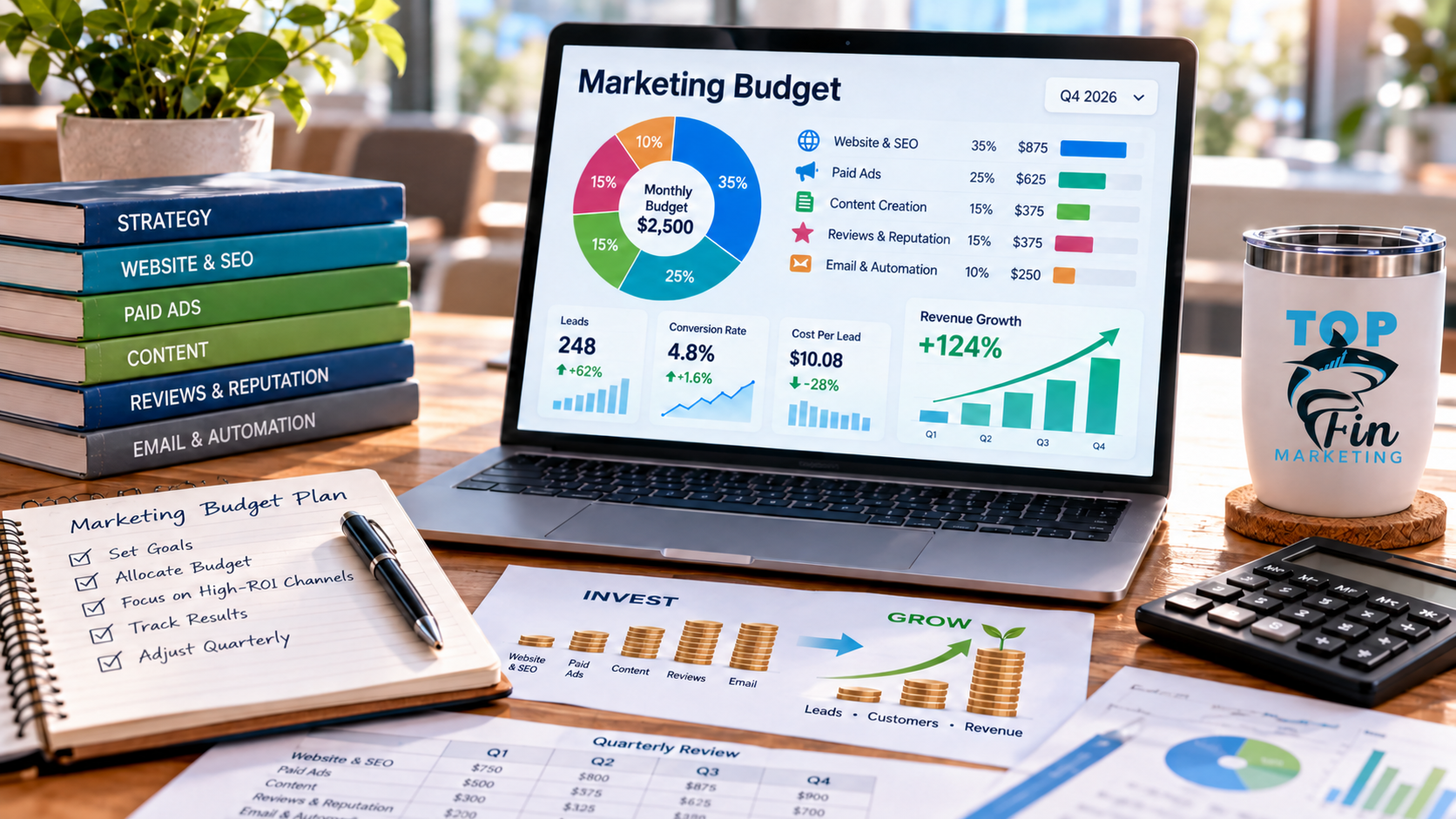
- Step 3: Break Your Budget Into Smart Categories
- Step 4: Define What ROI Actually Means
- Step 5: Focus on Conversion Optimization
- Step 6: Build for Long-Term Compounding
- Step 7: Review Quarterly — Not Emotionally
- Step 8: Align Marketing With Business Goals
- Step 9: Don’t Forget Internal ROI
- The Bottom Line
- Frequently Asked Questions
Step 1: Stop Thinking of Marketing as an Expense
One of the biggest mindset shifts a business owner can make is this:
Marketing is not overhead. It is a growth engine.
Rent keeps the lights on. Payroll keeps operations running.
Marketing brings in revenue.
When you treat marketing like a discretionary cost, it becomes the first thing cut when things get tight — which often makes things worse. When you treat it like a revenue-generating asset, you begin measuring it differently.
The goal is not “spend less.”
The goal is “earn more per dollar spent.”
Step 2: Decide Your Budget Using Revenue Benchmarks
A common question is: How much should I spend on marketing?
While it varies by industry, here are general benchmarks:
-
Established service businesses: 5–10% of gross revenue
-
Growth-stage businesses: 10–15% of gross revenue
-
Aggressive expansion mode: 15–20% or more
For example:
-
A $500,000 business spending 8% would allocate $40,000 annually.
-
A $1 million business investing 12% would allocate $120,000 annually.
The key is consistency. A predictable monthly budget allows you to build compounding results instead of chasing short-term spikes.
Step 3: Break Your Budget Into Smart Categories
Throwing money into “marketing” without structure is where ROI disappears.
A high-performing marketing budget typically includes:
1. Foundation (Long-Term Assets)
-
Website development & optimization
-
SEO
-
Branding and messaging
-
Content creation
These build equity in your business. They take time — but they compound.
2. Lead Generation (Immediate Opportunities)
-
Google Ads
-
Social media ads
-
Local service ads
-
Email campaigns
These drive quicker traffic and measurable leads.
3. Authority & Trust
-
Reputation management
-
Review generation
-
Case studies
-
Educational content
This increases conversion rates and lowers customer acquisition costs over time.
The mistake many businesses make is over-investing in ads while under-investing in the foundation. Paid ads without a strong website and SEO strategy are like pouring water into a leaky bucket.
Step 4: Define What ROI Actually Means
Return on investment is not just clicks or impressions. It’s revenue.
To calculate real ROI, you need to track:
-
Cost per lead
-
Cost per acquisition (CPA)
-
Average customer value
-
Lifetime customer value
For example:
-
$2,000 ad spend
-
40 leads generated
-
10 closed sales
-
Average job value = $2,500
Revenue = $25,000
Ad spend = $2,000
Gross ROI = 12.5x return
Now that’s clarity.
Without tracking these numbers, marketing becomes guesswork.
Step 5: Focus on Conversion Optimization
Many businesses try to increase ROI by increasing traffic.
Often, the smarter move is increasing conversion rate.
If your website converts at 2% and you improve it to 4%, you just doubled revenue without increasing traffic.
Ways to improve conversion:
-
Clear calls to action
-
Faster page load speeds
-
Mobile optimization
-
Strong testimonials
-
Clear service descriptions
-
Simple contact forms
Small improvements here often outperform large ad budget increases.
Step 6: Build for Long-Term Compounding
The highest ROI marketing channels are often:
-
SEO
-
Google Business Profile optimization
-
Content marketing
-
Email nurturing
These don’t always show immediate results — but they build momentum.
For example, ranking organically in Google for a high-value keyword can generate leads for years without paying per click.
Paid ads stop when you stop paying.
SEO builds equity.
A balanced budget invests in both.
Step 7: Review Quarterly — Not Emotionally
Many business owners make marketing decisions emotionally:
-
“We didn’t get calls this week — shut it off.”
-
“We had a slow month — cut ads.”
-
“We got busy — stop marketing.”
This creates instability.
Instead, review performance quarterly. Look at trends, not daily fluctuations.
Ask:
-
Are leads increasing?
-
Is cost per acquisition improving?
-
Is revenue trending upward?
Data-driven decisions outperform emotional decisions every time.
Step 8: Align Marketing With Business Goals
Your budget should reflect your goal.
If your goal is:
-
Stability → Invest in retention and reputation
-
Growth → Invest in SEO and advertising
-
Expansion → Invest heavily in lead generation and brand authority
Marketing without a defined objective is just activity.
Marketing aligned with growth targets is strategy.
Step 9: Don’t Forget Internal ROI
Marketing ROI is not just external. Internal systems matter.
If leads come in but:
-
Calls aren’t answered
-
Follow-ups are slow
-
Sales scripts are weak
-
Reviews aren’t requested
You are losing ROI after the lead is generated.
Often, improving internal processes can double marketing returns without increasing spend.
1. How much should a small business spend on marketing?
Most small businesses should allocate between 5–15% of gross revenue depending on growth goals. If you are aggressively expanding, expect to invest more. If you are maintaining stability, you may invest on the lower end.
The key is consistency and tracking performance metrics.
2. Should I focus on SEO or paid ads first?
Ideally, both — but if budget is limited, start with foundational SEO and website optimization. Paid ads work best when your website converts well and your online presence builds trust.
SEO builds long-term equity. Paid ads generate faster results. A balanced approach typically produces the strongest ROI
3. How long does it take to see ROI from marketing?
Paid advertising can generate leads within weeks. SEO and content marketing typically take 3–6 months to show measurable traction and 6–12 months for strong momentum.
The businesses that see the highest ROI are those that stay consistent and allow marketing to compound over time.