
SEO Glow-Up Guide: How to Make Your Website More Search-Friendly
Jump to a Section
SEO has a reputation for being painfully technical: algorithms, crawling, canonical URLs, title tags, backlinks, schema, keywords, indexing—the list can start sounding like a foreign language pretty quickly.
But the basic idea is actually much simpler.
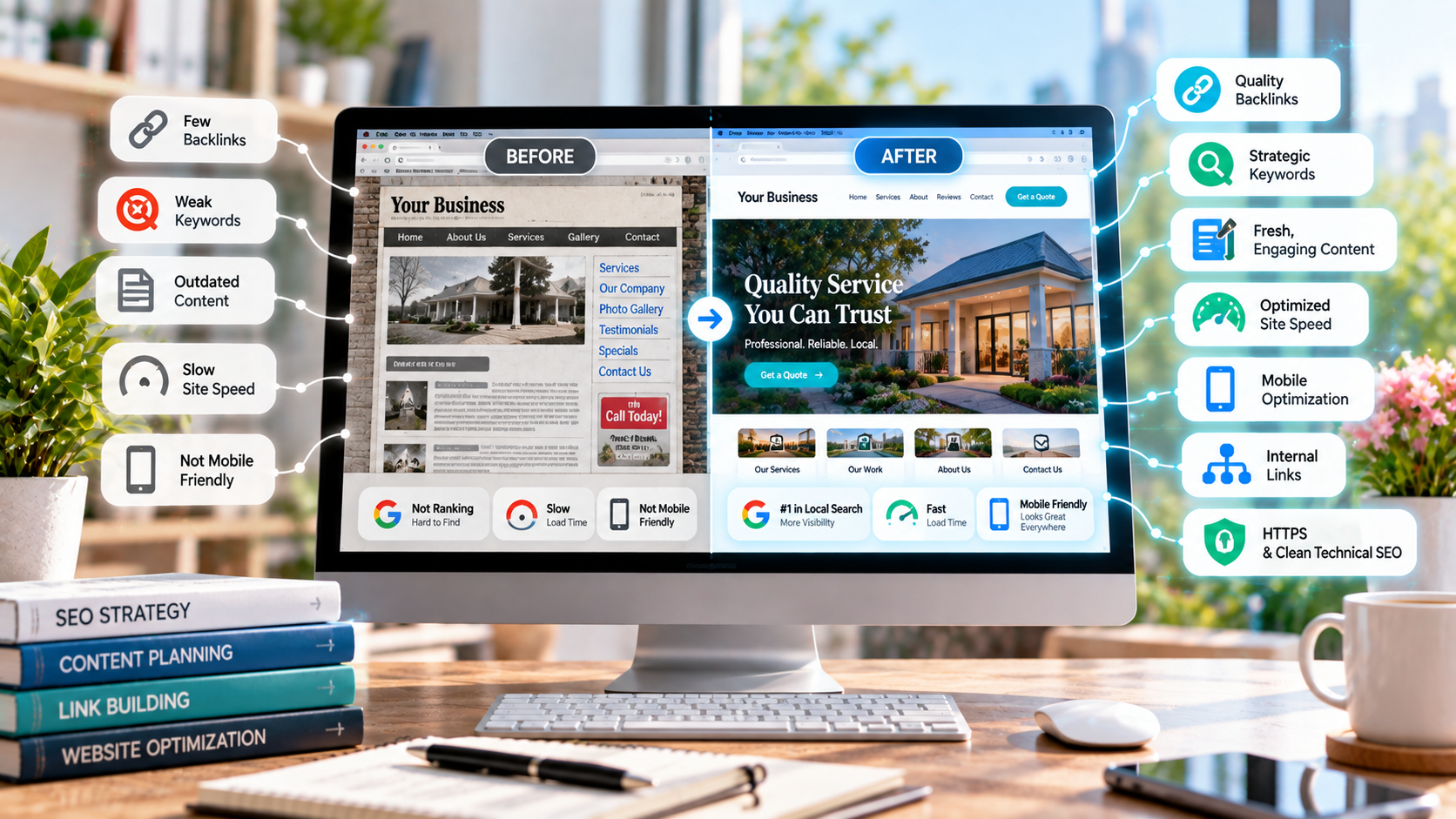
A good SEO strategy is essentially a website glow-up. You improve the substance, presentation, structure, authority, and clarity of the website so that customers can use it more easily and search engines can better understand what the business offers.
No secret button. No magic keyword density. No ritual sacrifice to the Google algorithm.
Just a stronger website and a clearer digital presence.
A strong SEO refresh usually combines better content, clearer service and location information, useful keywords, improved website structure, technical cleanup, stronger internal linking, legitimate backlinks, better user experience, accurate business information, and ongoing measurement.
The goal is not to trick Google into liking your website. The goal is to make the website easier for both people and search engines to understand and trust.
Step 1: Show Up Consistently—But Don't Publish Just to Publish
The old advice was simple:
“Publish something every month so Google knows you're alive.”
There is a better way to think about it.
Google does recommend keeping content accurate and up to date where appropriate. But that does not mean every business needs to publish an arbitrary monthly article to keep Google happy.
A stale website can absolutely become a problem when:
- Services have changed
- Prices or policies are outdated
- Locations are incorrect
- Staff information is obsolete
- Articles contain outdated facts
- Broken links accumulate
- Important industry information changes
That is different from saying a three-week-old article is somehow better than a three-year-old article simply because it is newer.
Freshness Should Have a Reason
Update content when the information needs updating. Add new content when there is a useful subject worth covering. Do not create filler articles simply to satisfy an imaginary publishing quota.
So How Often Should You Blog?
There is no universal answer.
Some businesses can produce a genuinely useful article every week. Others may be better off publishing one excellent resource every month or even less frequently.
The original version of this article referenced a monthly blogging routine . A publishing routine can certainly help with consistency, but the calendar should serve the content—not the other way around.
For a deeper look at why educational content can help search visibility, see How Informative Blog Articles Help Rank Your Website .
↑ Back to TopStep 2: Give Your Website a Reputation Boost With Better Backlinks
Think of backlinks as the internet version of other credible people saying:
“Yes, this business or resource is worth knowing about.”
Google still uses link analysis and PageRank within its broader ranking systems, so backlinks remain important.
But backlinks are not Pokémon.
You do not need to collect every one you can find.
Relevant
Links should have some logical relationship to your business, industry, audience, geography, or content.
Legitimate
Strong links usually come from real organizations, publications, relationships, resources, or editorial decisions.
Useful
Ideally, the link should make sense even if Google did not exist and should have potential value for actual visitors.
Good Places to Earn Backlinks
- Local chambers of commerce
- Industry associations
- News outlets
- Professional organizations
- Suppliers and manufacturers
- Community organizations
- Legitimate directories
- Guest contributions to relevant publications
- Local events and sponsorships
- Useful content other websites genuinely want to cite
Quality beats backlink glitter. Five meaningful links from relevant, trustworthy sources can be far more useful than hundreds of random links created simply to make an SEO report look impressive.
We break backlink strategy down in much greater detail in Backlinks: The Backbone of SEO Success .
↑ Back to TopStep 3: Don't Catfish Google—or Your Customers
A good SEO strategy needs consistency between what the business says it does and what the website actually demonstrates.
If your homepage claims you are:
“The leading nationally recognized authority on luxury commercial architecture”
but the website contains three stock photos and a paragraph that could describe almost any contractor in America, the story does not match the evidence.
Match Your Content to the Real Business
Clearly explain:
- What you actually do
- Who you serve
- Where you operate
- What makes you different
- What experience you have
- What services you actually offer
Use Real Evidence
Useful credibility elements may include:
- Real project photography
- Case studies
- Team information
- Licensing information where relevant
- Customer reviews
- Industry memberships
- Original explanations and expertise
Make the Website Match the Business
Search engines need context. Customers need confidence. Accurate, specific content helps both.
Step 4: Give the Website an Actual Glow-Up
SEO cannot rescue a website that customers hate using.
A polished website should feel easy, clear, and credible.
Fast
Large images, bloated scripts, unnecessary third-party tools, and poor hosting can turn a simple page into a patience test.
Mobile-Friendly
Navigation, buttons, forms, text, and calls to action should work properly on smaller screens.
Easy to Understand
Visitors should quickly understand what the company offers and what they should do next.
Use Better Visuals
Real photos of your business, employees, projects, products, office, customers, or work can provide context that generic stock photography simply cannot.
Remove Friction
Check for:
- Broken buttons
- Forms that do not submit
- Phone numbers that are not clickable on mobile
- Navigation that makes no sense
- Popups blocking the entire screen
- Pages that take forever to load
- Text that is difficult to read
- Calls to action buried beneath unnecessary clutter
And Please Retire the 2004 Website
No auto-playing music. No flashing text. No tiny fonts. And unless your brand has a very specific reason for it, Comic Sans can continue enjoying its retirement.
Step 5: Use Keywords Like Introductions, Not Pickup Lines
Keywords help search engines understand what a page is about and connect that page with relevant searches.
But modern SEO is not about stuffing an exact phrase into every possible sentence.
Start With Search Intent
Instead of asking only:
“Which keyword should I target?”
also ask:
“What is this person actually trying to accomplish when they search?”
A search for:
- “AC repair Mobile AL”
- “why is my AC blowing warm air?”
- “repair or replace air conditioner?”
involves the same general subject but three different intentions.
Write Naturally
Google's language systems can understand related wording and concepts. You do not need to repeat an awkward exact-match phrase fourteen times.
Keywords should help introduce the page. They should not make your writing sound like a malfunctioning robot desperately trying to impress a search engine.
Search behavior is also evolving quickly. We cover some of those changes in our updated guide to the top SEO trends to watch .
↑ Back to TopStep 6: Make the Content Actually Worth Reading
This sounds obvious.
Somehow, the internet proves daily that it is not.
Great SEO content should help somebody accomplish something.
Answer
Give clear answers to the questions customers genuinely ask.
Explain
Make complicated subjects easier for customers to understand.
Demonstrate
Use experience, examples, projects, case studies, photos, or data to demonstrate genuine knowledge.
Bring Something to the Conversation
Do not simply rewrite what ten other websites already said.
Add:
- Your experience
- Your process
- Your observations
- Original photos
- Examples
- Local knowledge
- Case studies
- Useful comparisons
- Real answers to customer questions
Personality Is Allowed
Professional does not have to mean boring.
If your brand has personality, let some of it show. Clear writing, useful examples, humor where appropriate, and a recognizable voice can make content much easier to read.
People-First Does Not Mean SEO-Free
You can structure headings, research keywords, optimize titles, add internal links, and improve search visibility while still writing for actual humans. The two goals should support each other.
Step 7: Give Google a Clear Path Through the Website
Technical SEO sounds intimidating because the term includes everything from simple title tags to server responses and JavaScript rendering.
For many small and midsize business websites, however, a large portion of the foundation comes down to keeping the site organized and accessible.
Write Clear Page Titles
Each important page should have a useful, descriptive title that accurately explains the page's subject.
Use Logical Headings
Break content into sections with descriptive headings so both users and search engines can follow the structure.
Build Useful Internal Links
Connect related services, articles, locations, and resources instead of leaving every page isolated.
Use Descriptive Image Alt Text
Alt text should describe the image appropriately and provide useful context rather than functioning as a place to stuff keywords.
Maintain a Clean Sitemap
An XML sitemap can help search engines identify important URLs, particularly on larger or changing websites.
Check Indexability
Make sure important pages have not accidentally been blocked, redirected, canonicalized elsewhere, or tagged noindex.
Fix Broken Links and Redirects
Remove dead ends, repair broken internal links, and make sure URL changes use appropriate redirects.
Use HTTPS
Your website should operate over a secure HTTPS connection.
Google's own SEO Starter Guide is a useful reference for many of these fundamentals.
Technical SEO is basically good housekeeping with consequences. Give search engines a logical, accessible website instead of making them crawl through the digital equivalent of a junk drawer.
Step 8: If You're a Local Business, Give Your Local Presence a Glow-Up Too
A beautiful website is only part of the equation for a business that depends on customers in a specific geographic market.
Your local SEO should reinforce the same business identity.
Google Business Profile
Keep your category, services, address or service area, website, phone number, hours, and other profile information accurate.
Reviews
Build a consistent process for asking real customers for legitimate reviews and respond professionally to feedback.
Local Content
Explain where you operate, showcase real projects, create appropriate location pages, and provide local context where it genuinely helps the customer.
Local Backlinks
Chambers, local publications, community organizations, suppliers, professional groups, sponsorships, and regional partnerships can help build a stronger local presence.
Keep Everything Consistent
Your website, Google Business Profile, citations, map presence, phone number, service areas, location content, and broader online identity should all make it clear that they represent the same real-world business.
For a much deeper walkthrough, see How to Rank in Google's Local Map Pack .
↑ Back to TopStep 9: Measure the Glow-Up With Numbers That Actually Matter
You cannot judge SEO by staring at one keyword ranking every morning.
Look at the bigger picture.
Visibility
Are impressions, keyword coverage, local visibility, and important page rankings improving?
Traffic
Are more relevant users reaching the website through organic search?
Business Results
Are organic search visitors calling, submitting forms, requesting quotes, booking appointments, or purchasing?
Use Search Console
Google Search Console can help you understand:
- Queries producing impressions
- Pages receiving search clicks
- Indexing problems
- Average search positions
- Changes in search visibility
Use Analytics
Analytics can help you understand what happens after users reach the website:
- Landing pages
- Traffic sources
- Conversions
- User journeys
- Engagement patterns
Rankings are useful. Revenue is more useful. The purpose of SEO is not to win a screenshot contest. It is to put the business in front of relevant people and turn more of those opportunities into actual business.
What Should You Stop Obsessing Over?
A proper glow-up also involves throwing some outdated SEO baggage in the trash.
Arbitrary Word Counts
There is no magic 1,500-word threshold that makes Google fall in love with an article. Write enough to cover the subject properly.
Meta Keywords
Google does not use the meta keywords tag for ranking.
Keyword Density Formulas
There is no ideal percentage where repeating a phrase 2.7% of the time suddenly unlocks page one.
Publishing for the Sake of Publishing
A calendar does not outrank quality.
Chasing Every Algorithm Rumor
Search changes constantly, but businesses do not need to redesign their entire strategy every time someone on social media announces that “SEO is dead again.”
One-Metric SEO
Domain Authority, bounce rate, backlink count, word count, PageSpeed score, review count, and individual rankings can all provide useful information.
None tells the complete story by itself.
Keep Up With What Actually Changes
Search does evolve, particularly with AI-assisted results, local search, video, images, and changing user behavior. Our Top SEO Trends to Watch guide covers some of the larger changes worth paying attention to.
The SEO Glow-Up Checklist
If your website is overdue for some attention, start here:
- Update outdated service, location, staff, and contact information.
- Improve weak core service and product pages.
- Research how customers actually search for your services.
- Match pages to search intent rather than stuffing keywords.
- Add genuinely helpful informational content.
- Strengthen internal links between related pages.
- Fix broken links, redirects, and indexation issues.
- Improve mobile usability and page performance.
- Replace weak stock imagery with strong original visuals where possible.
- Earn legitimate backlinks from relevant sources.
- Improve Google Business Profile information if local SEO matters.
- Build and manage a legitimate customer review strategy.
- Review Search Console for indexing and search-performance issues.
- Measure leads and conversions instead of rankings alone.
- Revisit important content when facts, markets, services, or customer needs change.
Don't Try to Fix Everything at Once
Prioritize the problems that have the biggest effect on visibility, usability, and conversions. Fixing five meaningful weaknesses is often more valuable than changing fifty tiny details because an SEO audit tool colored them yellow.
Frequently Asked Questions
How long does an SEO glow-up take to show results?
There is no universal timeline. Google says some changes can be reflected within hours while others may take several months, and it generally recommends allowing at least a few weeks before evaluating whether changes had a meaningful effect. Competition, crawl frequency, website authority, the scope of the work, and the type of change all matter.
Do I need to update my SEO strategy regularly?
Yes, but that does not mean rebuilding everything every month. Businesses change, competitors improve, search behavior evolves, content becomes outdated, links disappear, and technical problems can develop. Periodic review is part of maintaining a healthy search presence.
Do I need to publish a new blog every month?
No. A monthly schedule can be useful if you have worthwhile topics and the ability to create strong content consistently, but there is no requirement that every business publish on an arbitrary monthly schedule. Quality and relevance matter more than filling a calendar.
What's the biggest mistake businesses make after improving their SEO?
One of the most common mistakes is assuming SEO is permanently finished. A strong foundation can last, but important content, technical health, reviews, links, competitors, services, and search demand should continue to be monitored over time.
Can redesigning my website improve SEO?
It can if the redesign improves usability, speed, mobile performance, content quality, site structure, internal linking, accessibility, or conversion paths. A redesign can also hurt SEO if URLs, redirects, content, metadata, or indexation are handled poorly during the transition.
Are backlinks still important?
Yes. Google still uses link analysis and PageRank within its ranking systems. The focus should be on legitimate, relevant links rather than maximizing backlink count through low-quality link schemes.
How many keywords should one page target?
There is no magic number. A strong page should usually satisfy one primary search intent while naturally covering the related language and subtopics needed to explain that subject well.
Does updating an old article automatically improve rankings?
No. Updating content simply to change the date does not guarantee improvement. Updates are most useful when they make the page more accurate, complete, current, relevant, or helpful.
Is technical SEO more important than content?
They solve different problems. Great content cannot perform well if search engines cannot access or index it, while a technically perfect website with weak content may have little worth ranking. Strong SEO usually requires both.
Does a beautiful website automatically rank better?
No. Visual design alone is not a ranking strategy. The design should support usability, accessibility, clarity, mobile performance, credibility, and conversions while the broader SEO foundation handles relevance, content, technical accessibility, authority, and other search factors.
Can AI help with an SEO glow-up?
AI can help with research organization, content ideation, analysis, drafting, editing, and other workflows. It should not replace factual verification, business expertise, editorial judgment, original experience, or a real strategy.
Should I hire an SEO company or do it myself?
Many fundamentals can be handled internally if the business has the time and expertise. More competitive campaigns often benefit from professional help with technical SEO, content planning, local search, backlinks, analytics, competitive research, and ongoing strategy.
Final Thoughts: Make Your Website Too Useful to Ignore
SEO is not magic.
It is clarity.
It is structure.
It is credibility.
It is useful content, good technology, strong authority, accurate information, and showing up in the right places for the right searches.
A real SEO glow-up does not involve adding a few keywords, changing the homepage title, and hoping Google becomes obsessed with you overnight.
It means improving the entire digital presentation of the business:
- Better content
- Better structure
- Better technical health
- Better backlinks
- Better local signals
- Better user experience
- Better measurement
When those pieces work together, the website becomes easier for search engines to understand and considerably more useful to the people you actually want as customers.
That is the kind of glow-up worth investing in.
Is Your Website Ready for an SEO Glow-Up?
Top Fin Marketing can evaluate your website structure, content, keywords, technical SEO, backlinks, local presence, Google Business Profile, reviews, internal linking, search visibility, and competitive landscape to identify the improvements most likely to matter.
Learn more about our Search Engine Optimization services or contact us directly to discuss your website.
Contact Top Fin Marketing